10 Regression Review
Settling In
- Sit with your assigned group
- Catch up on any recent posts you’ve missed on Slack
- Open the Group Assignment 1 instructions and prepare to take notes (start a new QMD)
Notes: Preparing for Quiz 1
Logistics
- Topic: Regression (Units 0–3), including both concepts and code
- Questions will range in style: multiple choice, fill in the blank, short response, matching, etc.
- On paper (no computers)
- Closed notes, except for an instructor-provided R notesheet
- Can use the whole 90-minute class period (but hopefully won’t need to!)
Context
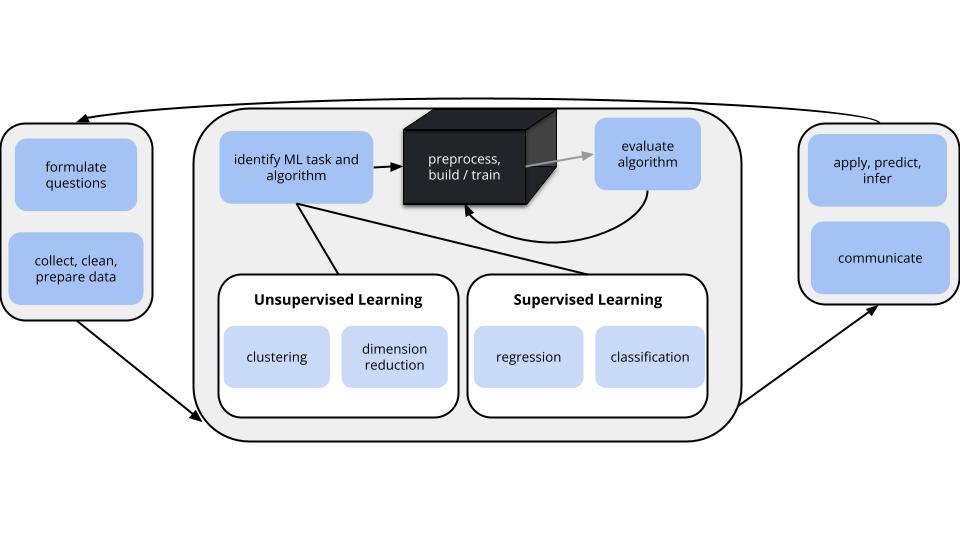
What have we covered so far?
For the Regression task:
- Unit 0: What is Regression? (And how does it differ from other types of Machine Learning tasks?)
- Unit 1: Evaluating regression models
- Unit 2: Building regression models / selecting predictors
- Unit 3: Building flexible (nonparametric, nonlinear) regression models
General concepts that translate to other ML tasks:
- Overfitting
- Cross validation
- Bias-variance tradeoff
- Algorithms and tuning parameters
- Preprocessing steps
- Parametric vs nonparametric models
Review & Reflection
STAT 253 is a survey course of statistical machine learning techniques and concepts. It’s important to continuously reflect on these and how they fit together. Though you won’t hand anything in, or work on this in class today, you’re strongly encouraged to complete this activity. The materials linked below are designed to help you reflect upon:
- ML concepts
- enduring, big picture concepts
- technical concepts
tidymodelscode
- Your progress toward…
- engagement
- collaboration
- preparation (checkpoints)
- exploration (homework)
Find and make a copy of the following 2 resources. You’ll be given some relevant prompts below, but you should use these materials in whatever way suits you! Take notes, add more content, rearrange, etc.
Concept Maps
Mark up slides 1–5 of the concept map with respect to the prompts below. Much of this overlaps with HW3.
Enduring, big picture concepts
IMPORTANT to your learning: Respond in your own words.
- When do we perform a supervised vs unsupervised learning algorithm?
- Within supervised learning, when do we use a regression vs a classification algorithm?
- What is the importance of “model evaluation” and what questions does it address?
- What is “overfitting” and why is it bad?
- What is “cross-validation” and what problem is it trying to address?
- What is the “bias-variance tradeoff”?
Technical concepts
On slide 2, identify some general themes for each model algorithm listed in the lefthand table:
- What’s the goal?
- Is the algorithm parametric or nonparametric?
- Does the algorithm have any tuning parameters? What are they, how do we tune them, and how is this a goldilocks problem?
- What are the key pros & cons of the algorithm?
For each algorithm, you should also reflect upon these important technical concepts:
- Can you summarize the steps of this algorithm?
- Is the algorithm parametric or nonparametric? (addressed above)
- What is the bias-variance tradeoff when working with or tuning this algorithm?
- Is it important to scale / pre-process our predictors before feeding them into this algorithm?
- Is this algorithm “computationally expensive”? What factors affect the computation time/cost?
- Can you interpret the technical (RStudio) output for this algorithm? (eg: CV plots, etc)?
Model evaluation
On slide 2, do the following for each model evaluation question in the righthand table:
- Identify what to check or measure in order to address the question, and how to interpret it.
- Explain the steps of the CV algorithm.
Algorithm comparisons
- Use slide 3 to make other observations about the Unit 1-3 modeling algorithms and their connections.
- Use slide 4 to address and compare the interpretability & flexibility of the Subset Selection (e.g. backward stepwise), LASSO, and Least Squares algorithms. Where would you place Splines and KNN on this graphic?
tidymodels Code Comparison
Check out and reflect upon the tidymodels code comparisons here. Copy, use, tweak, and add to this in whatever way suits you!
(Coming Soon!) Learning Reflection 1
The reflections above address your understanding of key machine learning concepts. Now that we are over a third of the way through the semester, I’d also like you to take some time to reflect on your engagement with the course and your progress toward the course learning goals (here and here).
To this end, you will complete the first of our three Learning Reflection assignments. More detailed instructions coming soon!
Learning Reflection 1 Deadline: Tuesday, October 21.
Other Study Tips
- Create a study guide using the course learning goals
- Review past checkpoints, in-class exercises, and homework problems (and try quizzing yourself!)
- Come to office hours (mine and preceptors)!
- Complete the provided review activities:
- Concept maps
tidymodelscode comparison- Group Assignment 1
Exercises
Use the rest of class time today to work on Group Assignment 1!
- Goal for Day 1: finish steps 1–5 and start step 6.
- Goal for Day 2: finish steps 7–9.
- (You will also likely need to do some work outside of class time. Plan accordingly!)
A few suggestions/reminders:
- Carefully review the instructions and rubric to ensure that you’ve included all requested information in the appropriate section
- Each group will submit one (HTML) report, using the provided template
- Each individual will complete the Group Assignment Feedback Survey
- Deadline: end-of-day Friday, October 10
Wrapping Up